
RBI Grade B 2027 Preparation Strategy: My Complete Roadmap to Crack RBI Grade B in First Attempt
Planning to prepare for RBI Grade B 2027? In this guide, Ashutosh Sharma shares his complete preparation strategy, study plan, subject-wise tips, common mistakes, and practical advice to help you crack the exam in your first attempt.
RBI GRADE B
Ashutosh Sharma, your RBI Mentor
7/17/202611 min read
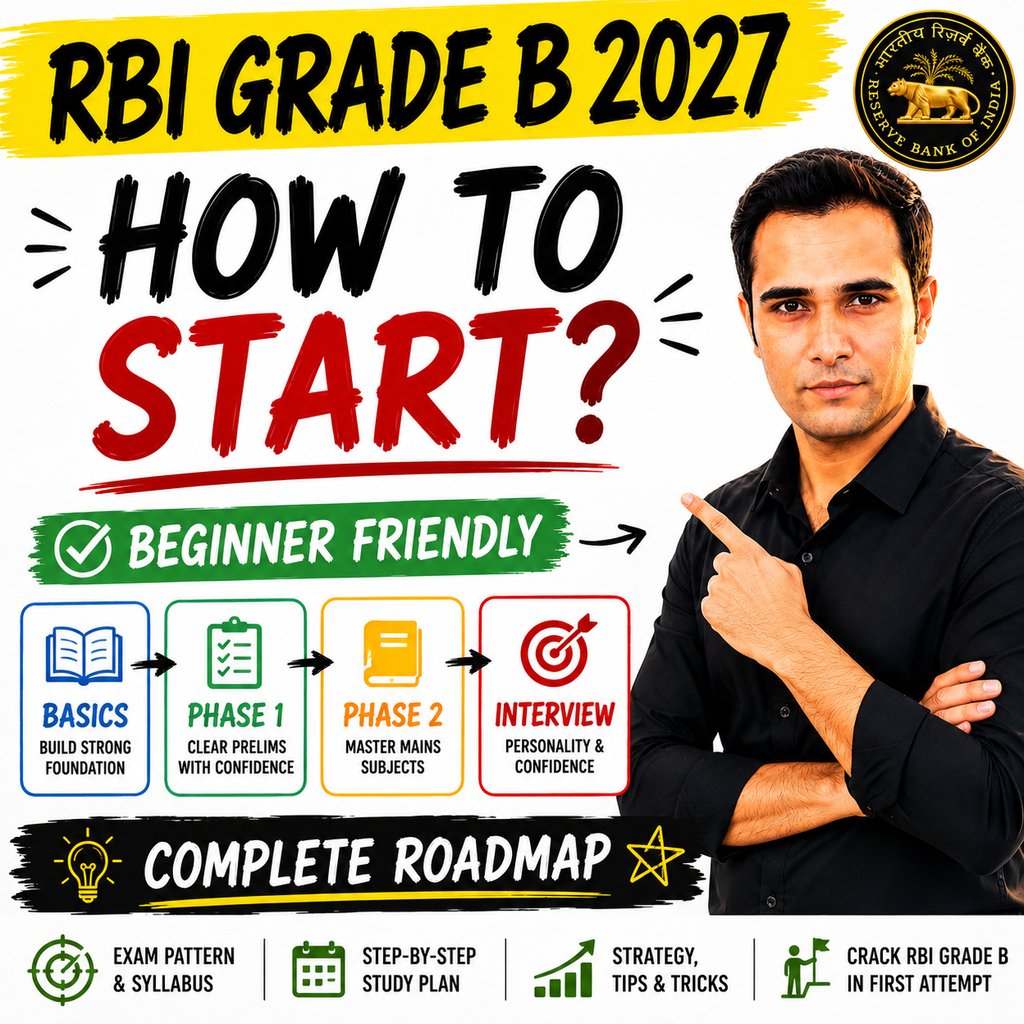
Table of Contents
Why You Should Start Preparing Now
Understand the RBI Grade B Exam First
My Preparation Philosophy
Step 1: Build Your Foundation
Step 2: Prepare Phase 1 & Phase 2 Together
Step 3: Stop Collecting Resources
Step 4: Subject-wise Strategy
Step 5: Mock Tests & PYQs
Step 6: Revision Strategy
Common Mistakes
FAQs
Topics Covered
Start Your Preparation
If You're Serious About RBI Grade B, Read This First
Every single day, I receive messages like these.
"Sir, I'm a beginner. Can I still crack RBI Grade B?"
"Sir, I've wasted the last six months. Is it too late?"
"Sir, everyone says RBI Grade B is one of the toughest exams. Should I even try?"
If you've ever asked yourself any of these questions, I want you to know something.
You're not alone.
In fact, almost every successful RBI Grade B aspirant starts with the same doubts.
The difference isn't confidence.
The difference is what they do after having those doubts.
Some students keep waiting.
Others start preparing.
And the ones who start—even if they're confused—are usually the ones who eventually succeed.
Why I Wrote This Article
When I started mentoring RBI Grade B aspirants, I noticed a common pattern.
Students weren't lacking motivation.
They were lacking clarity.
They had:
Twenty PDFs saved on their laptop.
Five different Telegram channels.
Ten YouTube playlists.
Three different book recommendations.
But they still didn't know one simple thing.
"What should I study today?"
That's why I decided to write this guide.
Think of this article as if we're sitting together over a cup of coffee and discussing your preparation.
I'm going to tell you exactly what I would do if I were starting RBI Grade B preparation from zero today.
My Biggest Advice: Don't Wait for the Notification
If I could give only one piece of advice to every RBI Grade B aspirant, it would be this.
Don't wait for the notification.
Every year, students tell me,
"Sir, I'll start once RBI releases the notification."
It sounds reasonable.
But in reality, it puts unnecessary pressure on you.
The moment the notification comes out, social media explodes.
Everyone starts discussing cut-offs.
Study plans.
Mock tests.
Last-minute strategies.
Students suddenly realize they have to complete months of preparation in a very short time.
That's stressful.
Instead, imagine waking up on notification day knowing you've already completed most of the syllabus.
Wouldn't that feel much better?
That's exactly why starting early gives you a massive advantage.
Is RBI Grade B Really Difficult?
This is probably the question I hear the most.
My answer is always the same.
RBI Grade B is competitive, but it isn't impossible.
Thousands of aspirants apply every year.
Only a small percentage get selected.
But here's something many people forget.
Most applicants don't prepare consistently.
Some start too late.
Some keep changing resources.
Some ignore Phase 2 completely.
Some never analyse their mock tests.
The competition is real.
But disciplined preparation can put you far ahead of the average aspirant.
Don't compete with thousands of students.
Compete with the version of yourself from yesterday.
The Biggest Mistake I See Every Year
After mentoring students for years, I've noticed one mistake that keeps repeating itself.
Students spend more time planning than preparing.
They search:
Best books
Best coaching
Best timetable
Best YouTube channel
Best notes
Every single day.
Instead of opening a book and studying.
Remember this.
A simple strategy followed consistently will always beat a perfect strategy that never gets implemented.
My Preparation Philosophy
If you're preparing under my guidance, you'll notice I repeat one sentence again and again.
Consistency beats intensity.
You don't have to study 12 or 14 hours every day.
You don't have to finish one subject in a week.
You don't have to know everything immediately.
What you do need is consistency.
Study every day.
Revise every week.
Attempt mocks regularly.
Improve a little every month.
That's exactly how successful preparation is built.
Not through motivation.
But through discipline.
Step 1: Understand the Exam Before Opening Any Book
This is where I would start if I were preparing today.
Before studying Quant.
Before watching a YouTube lecture.
Before buying books.
I would spend one hour understanding the exam itself.
Know:
Phase 1
General Awareness
English Language
Quantitative Aptitude
Reasoning Ability
Your goal here is simple.
Clear the cut-off comfortably.
Phase 2
This is where the real competition begins.
It includes:
Economic & Social Issues (ESI)
Finance & Management (FM)
Descriptive English
Many students underestimate Phase 2.
Don't make that mistake.
Your final selection depends heavily on your performance here.
Interview
The interview isn't just about knowledge.
It's about personality.
Communication.
Confidence.
Awareness.
The good news?
These qualities can be developed over time if you prepare consistently.
One Thing I Want You to Remember
Don't prepare just to clear Phase 1.
Prepare to become an RBI Grade B Officer.
That small shift in mindset completely changes how you approach your preparation.
Step 2: My Subject-wise Preparation Strategy
Whenever students ask me,
"Sir, which subject should I start with?"
My answer is always the same.
Don't think of RBI Grade B as six different subjects.
Think of it as one exam where every subject contributes to your final selection.
Your goal isn't to become amazing at one subject.
Your goal is to become balanced across all subjects.
Here's exactly how I recommend preparing each one.
Quantitative Aptitude
Many students are scared of Quant.
Especially students from non-engineering backgrounds.
If that's you, let me tell you something.
You don't need to be a maths genius to clear RBI Grade B.
You need concepts.
And you need practice.
Whenever you study Quant, don't ask,
"How many questions did I solve today?"
Instead ask,
"Did I actually understand why this method works?"
Once your concepts become strong, speed naturally improves.
Topics I recommend covering first
Simplification
Number Series
Quadratic Equations
Percentage
Profit & Loss
Ratio
Average
Time & Work
Speed, Time & Distance
Data Interpretation
Don't jump directly into difficult DI sets.
Build confidence first.
Reasoning Ability
Reasoning is just like going to the gym.
If you practice regularly, it becomes easier.
If you stop practicing for two weeks, you'll notice the difference immediately.
That's why I always recommend solving at least a few reasoning questions every day.
Focus on:
Seating Arrangement
Puzzles
Syllogism
Inequalities
Blood Relations
Coding-Decoding
Direction Sense
Initially, puzzles may take 20 minutes.
That's okay.
Over time you'll solve the same puzzle in 6–7 minutes.
Trust the process.
English Language
Please don't prepare English only for the exam.
Prepare it for your career.
Good communication helps you not only in RBI Grade B but throughout your professional life.
Every day, spend some time reading.
Editorials.
Business news.
Economic articles.
Government reports.
Slowly your vocabulary, comprehension and writing skills improve naturally.
Also practice:
Reading Comprehension
Cloze Tests
Error Detection
Para Jumbles
Vocabulary
For Phase 2, don't ignore descriptive writing.
Writing improves only when you actually write.
General Awareness
If there's one subject that can change your Phase 1 score dramatically, it's this.
But here's the mistake students make.
They study current affairs only one month before the exam.
Please don't do that.
Instead, make current affairs part of your daily routine.
Even 30–45 minutes every day is enough.
Focus on:
RBI News
Monetary Policy
Banking News
Government Schemes
Budget
Economic Survey
International Organisations
Financial News
Consistency matters much more than studying 12 hours of current affairs in one weekend.
Economic & Social Issues (ESI)
Many beginners get scared the moment they hear ESI.
I understand why.
The subject sounds completely new.
But once you start studying it, you'll realise it's actually very logical.
Don't try to memorize everything.
Understand.
Ask questions like:
Why does inflation happen?
Why does RBI increase repo rate?
What causes unemployment?
How does financial inclusion help the economy?
The more curious you become, the easier ESI feels.
Finance & Management (FM)
This subject is often underestimated.
Please don't ignore it.
Finance requires conceptual understanding.
Management requires revision.
Prepare topics like:
Financial Markets
Financial System
RBI Functions
Leadership
Motivation
Ethics
Communication
Organizational Behaviour
Study a little every week instead of leaving everything for the last month.
My Biggest Advice for Phase 2
If you've read this far, I want you to remember one sentence.
Phase 1 gets you shortlisted.
Phase 2 gets you selected.
Please don't spend eight months preparing only for Phase 1.
The students who perform well usually prepare both phases together from the beginning.
Even if you study Phase 2 for just one hour every day, you'll have a huge advantage later.
Feeling Overwhelmed?
At this point, many students tell me,
"Sir, I understand the strategy... but I still don't know what to study every single day."
And honestly...
That's completely normal.
Having information is different from having a plan.
This is exactly why I started the RBI Selection System Course.
Every week, I'm personally involved in helping my students prepare.
Not just by teaching classes.
But by making sure they always know:
What to study this week
Which topics deserve more attention
Where they're making mistakes
How to improve continuously
How to stay consistent until the exam
We start from absolute zero, so even if you're beginning today, you won't feel left behind.
If you'd like structured guidance instead of preparing alone, I'd love to help you.
👉 Join the RBI Selection System Course using below link
https://bankersuniversity.learnyst.com/learn/RBI-Grade-B-Selection-System
Now let's continue with the preparation strategy.
Step 3: Stop Collecting Resources
Can I be a little honest here?
I think students today have too many resources.
Not too few.
Every week I receive messages asking,
"Sir, which PDF should I read?"
"Sir, which YouTube playlist is the best?"
"Sir, can you suggest one more book?"
Here's my answer.
Stop collecting.
Start completing.
One good source that you revise three times is far better than ten resources you never finish.
Don't confuse collecting material with making progress.
They're not the same thing.
Step 4: Previous Year Questions Are Your Best Teacher
If you ask me to recommend only one thing after completing every topic...
I'd say this.
Solve Previous Year Questions.
They teach you:
What RBI actually asks
Which topics are most important
The level of difficulty
The style of questions
Don't leave PYQs for the last month.
Make them a part of your weekly routine.
You'll learn much faster.
Step 5: My Daily Study Plan for RBI Grade B 2027
One of the most common questions I receive is:
"Sir, can you give me a daily timetable?"
Honestly, I don't believe there's one timetable that works for everyone.
A college student, a working professional, and someone preparing full-time all have different schedules.
Instead of following someone else's timetable, build a routine that you can actually follow every day.
If I were preparing for RBI Grade B today, my day would look something like this.
Morning
Current Affairs
Newspaper Reading
Banking & Economy News
Afternoon
Quantitative Aptitude
Reasoning Ability
Evening
English Language
Economic & Social Issues
Finance & Management
Before Sleeping
Spend 30–45 minutes revising whatever you studied during the day.
Never underestimate revision.
Most students don't forget because they're weak.
They forget because they never revise.
Step 6: How Many Hours Should You Study?
Let me answer this honestly.
You don't need to study 12 or 14 hours every day.
In fact, I don't recommend it.
I'd rather see a student study 6–8 focused hours consistently than study 14 hours for three days and then burn out.
Remember this.
The quality of your study matters far more than the number of hours you spend sitting at your desk.
When you study:
Keep your phone away.
Avoid multitasking.
Take short breaks.
Focus completely on one topic at a time.
Even four highly focused hours can be more productive than eight distracted hours.
Step 7: Mock Tests Will Change Your Preparation
Many students postpone mock tests because they're afraid of low scores.
If that's you, I want to change your perspective.
Mock tests are not there to judge you.
They're there to improve you.
When you give a mock test, don't ask:
"How many marks did I score?"
Instead ask:
Which section took the most time?
Where did I make silly mistakes?
Which concepts need revision?
What can I improve before the next mock?
The analysis after a mock test is often more valuable than the mock itself.
That's where real learning happens.
Step 8: Revision Is Your Superpower
If I had to choose between:
A student who studies ten subjects once...
And another student who studies five subjects but revises them three times...
I'd choose the second student every single time.
Revision creates confidence.
Without revision, even topics you've already studied begin to feel unfamiliar.
That's why I recommend:
Daily Revision
Weekly Revision
Monthly Revision
Don't keep moving forward without looking back.
Revision is what turns information into long-term memory.
The Biggest Mistakes I See Every Year
After interacting with thousands of RBI Grade B aspirants, I've noticed that the same mistakes keep repeating.
Let's make sure you don't make them.
❌ Waiting for the Notification
Starting late creates unnecessary pressure.
Start building your foundation today.
❌ Ignoring Phase 2
Many students prepare only for Phase 1.
Then they struggle with ESI, Finance & Management, and Descriptive English later.
Prepare both phases together.
❌ Using Too Many Resources
More PDFs don't mean better preparation.
One complete resource is always better than ten incomplete ones.
❌ Not Solving Previous Year Questions
PYQs help you understand RBI's mindset.
Make them a regular part of your preparation.
❌ Skipping Mock Tests
Mocks identify your weaknesses before the actual exam.
Don't avoid them.
Use them to improve.
❌ Comparing Yourself With Others
This is probably the most dangerous mistake.
Someone else's preparation journey has nothing to do with yours.
Instead of comparing yourself with another aspirant...
Compare yourself with who you were last month.
That's the comparison that matters.
One Final Message From Me
If you've read this article till the end...
Thank you.
It tells me one thing.
You're serious about becoming an RBI Grade B Officer.
And I genuinely respect that.
Before I end this article, I want to leave you with one thought.
You don't need to know everything today.
You don't need to be perfect.
You don't need to compete with thousands of aspirants every morning.
You just need to become a little better every single day.
Small improvements may not seem exciting.
But over the course of a year...
They completely transform your preparation.
So don't wait for Monday.
Don't wait for the notification.
Don't wait for the perfect study plan.
Start today.
Your future self will thank you for it.
🚀 Ready to Start Your RBI Grade B Journey?
If you've made it this far, chances are you're genuinely serious about RBI Grade B.
I'd love to help you throughout your preparation journey.
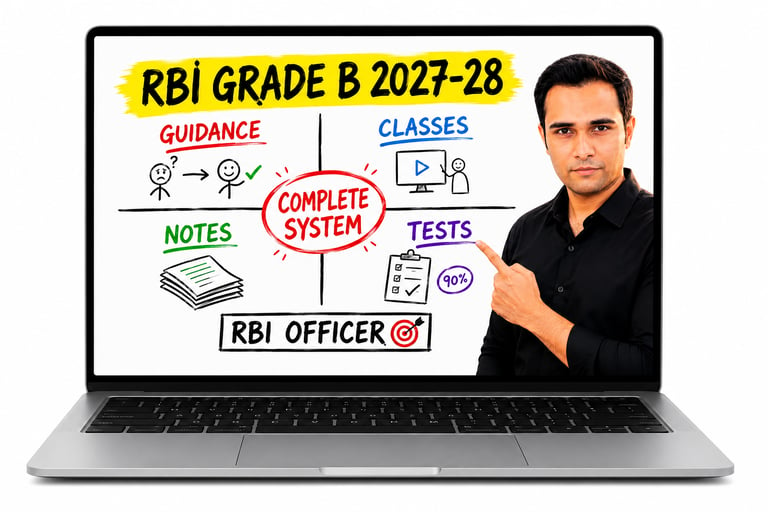
My classes for RBI Grade B 2027 & 2028 have already started inside the RBI Selection System Course.
Every week, I'll personally be involved in your preparation by helping you:
✅ Learn from absolute zero level
✅ Understand exactly what to study every week
✅ Identify and improve your weak areas
✅ Stay accountable and consistent
✅ Access complete Phase 1 & Phase 2 classes, mock tests, study material, and practice questions
No prior knowledge is required.
We start from scratch and gradually build your preparation to the level required to crack the RBI Grade B Exam.
👉 Join the RBI Selection System Course using below link
https://bankersuniversity.learnyst.com/learn/RBI-Grade-B-Selection-System
📲 Have a Question?
Feel free to WhatsApp me directly on 7986152868.
I'd be happy to guide you.
I hope to see you inside the course—and one day, see your name in the RBI Grade B final selection list.
– Ashutosh Sharma
Frequently Asked Questions (FAQs)
Can I crack RBI Grade B in my first attempt?
Yes. Every year, many candidates clear RBI Grade B in their first attempt. The key is to start early, prepare consistently, and follow a structured study plan.
Is RBI Grade B difficult for beginners?
It is competitive, but absolutely manageable for beginners who build strong fundamentals and prepare both Phase 1 and Phase 2 systematically.
Should I prepare for Phase 1 and Phase 2 together?
Yes. I strongly recommend preparing for both phases simultaneously. This reduces pressure after the Phase 1 result and improves your overall chances of selection.
How many hours should I study daily?
Instead of focusing on hours, focus on consistency. Five to seven hours of focused study every day is generally more effective than studying long hours inconsistently.
When should I start preparing for RBI Grade B 2027?
The best time to start is now. Early preparation gives you enough time for conceptual learning, revision, mock tests, and answer writing practice.
What's the expected RBI Grade B exam date?
You can know more about the RBI Grade B 2027 exam date on the specific blog on our website.
Topics Covered in This Article
In this complete guide, we discussed:
RBI Grade B 2027 Preparation Strategy
How to Prepare for RBI Grade B from Scratch
RBI Grade B Phase 1 Preparation
RBI Grade B Phase 2 Preparation
Subject-wise Preparation Strategy
Daily Study Plan
Mock Test Strategy
Revision Strategy
Previous Year Question Strategy
Common Mistakes to Avoid
FAQs for RBI Grade B Aspirants
Personal Guidance & Structured Preparation
Support:
bankersuniversityinbox@gmail.com
For queries: +91 7986152868